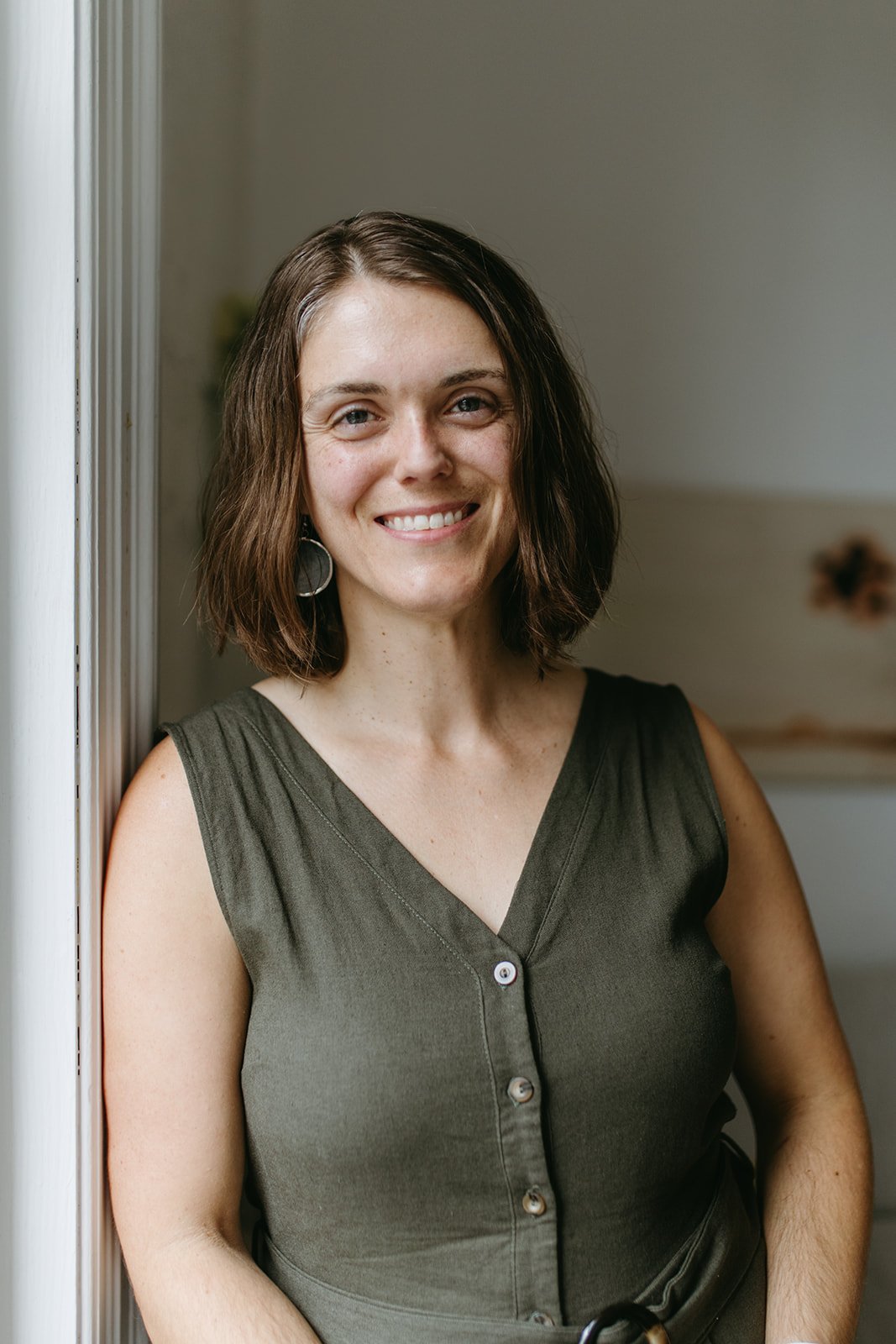
MICHELLE JONES, PERINATAL THERAPIST IN KITSAP COUNTY, WA
Welcome! I'm glad you're here. I'm Michelle.
I love working with clients who are somewhere on their journey of becoming a mother or parent, whether considering, pursuing, grieving, or juggling. My work centers on people who identify as mothers and gestational parents, though professional helpers and caregivers of all kinds tend to jive with me, too.
I'm a mom of two young kids, so I know life in the trenches and all the mixed feelings that come with motherhood: the love, the rage, the grief, the boredom, and the joy, sometimes all before breakfast. I'm also a trained perinatal psychotherapist. I bring both into the room.
Michelle Jones, MA, LMHC, PMH-C
My why
I can help because I've been there. Honestly, I'm still on my matrescence journey.
I'm living the same questions many of my clients bring: how to love my kids fiercely and still keep hold of myself, how to ask for help, how to find my people. Doing my own emotional work has changed how I show up as a mom, a partner, and a person. Now I get to help other moms and caregivers make space for that kind of growth, too.
I've been on both sides of connection.
I know what it's like to feel deeply supported, with people all around who are ready to show up. I also know what it's like to pull teeth for it. I've networked, asked around, and questioned everyone (yes, including my barber) about where the support was.
When our family moved from a bigger city to a smaller county, I learned something personally and professionally. Connection is vital, and safe spaces to find it are rare.
I see mothers and caregivers trying so hard to meet this need. There are broken conversations at the farmers market, quick hellos on the street, and playdates where no one finishes a sentence. Then we go home frustrated and discouraged and wonder why we even try.
What's missing isn't desire. The longing is everywhere. What's missing is a space built for it.
Focused, facilitated connection, with room to slow down and the gift of going second. And if I know mothers, we'll get scrappy even when we're empty, if there's something worth getting scrappy for.
I have a special place in my heart for mothers and caregivers after parental leave ends, when the formal supports fall away and you're left wondering who you're becoming. I bring both sides into the room: the real life of mom-overwhelm, burnout, and desire, and the clinical understanding of how shame keeps us isolated and how vulnerability brings us back.

Why “Thresholds”
Many have crossed here before you.
The name Thresholds holds two layers of meaning for me. The first comes from the Irish poet and philosopher John O'Donohue, whose threshold poetry in To Bless the Space Between Us has deeply influenced my work. The second is the image of an old stone threshold, worn smooth by all the feet that have crossed it: generations of women passing from maiden to mother, and each of us moving through matrescence and the other transitions that follow big change. It reminds me that so many have gone before us. We're part of families, histories, and systems far bigger than ourselves, and yet, in the middle of a big life change, it can feel like we're the only one walking through.
A threshold holds both truths. Your way through is uniquely yours, and it deserves to be witnessed. And you are not alone.
Generationally: The mothers and grandmothers whose stories still live in you.
Socially: The friends, neighbors, and community who can help hold you.
Internally: Your own wisdom, which knows more than you might think.
From maiden to mother
Becoming a mother is one of the oldest thresholds there is. In stories across cultures, the passage from maiden to mother marks the moment one version of you ends and another begins. Something is lost, something is born, and for a while you stand in the doorway between. My work is to keep you company there: honoring who you were, grieving what has changed, and getting curious about who you're becoming.
Why connection matters now
You're not failing. You're missing your village.
The village thinned out
Postpartum depression and anxiety are more common than ever. Many of us have lost the natural overlaps that once held new mothers and parents: family nearby, older women who've been there, neighbors who drop by.
Shame grows in isolation
Brené Brown's research shows that shame grows in secrecy, silence, and judgment, and that empathy is its antidote. Letting ourselves be seen, vulnerably, is how we find our way back.
Your brain changed, too
Pregnancy and early parenthood reshape your brain to scan for threats and keep your little ones safe. It's a remarkable adaptation, and it costs focus, memory, and capacity to connect. You're not losing it. You're carrying a lot.
That's why a real chunk of my work centers on connection: naming the shame and the barriers that keep us disconnected, and growing what helps us find our way back to each other: interpersonal skills, boundaries, staying regulated while we connect, managing expectations, and plenty of self-compassion.
How I work
Clarity, warmth, a little humor, and no fluff.
I'm warm, honest, and straightforward, and my style is conversational and real. I help you sort through emotional stuckness with clarity and a good dose of humor, because sometimes you have to laugh at how hard this is. We'll also get curious about the histories, cultures, and communities that shaped you, so you can set down what's heavy and keep what's wise.
My approach is relational psychotherapy, informed by attachment theory, British object relations, Internal Family Systems (IFS), Emotionally Focused Therapy (EFT), and psychodynamic theory. I weave in somatic practices and trauma-informed care, all within a strength-based, social justice framework.
My graduate training at The Seattle School of Theology & Psychology taught me that good therapy makes room for the whole person: body, mind, relationships, and whatever gives your life meaning. I work with mothers, gestational parents, and caregivers of every belief system, background, and family shape.
Training & credentials
Licensed Mental Health Counselor, Washington State (LH61506784)
MA in Counseling Psychology, The Seattle School of Theology & Psychology (2019)
Perinatal Mental Health Certification (PMH-C)
Advanced training through Postpartum Support International
Additional training in narrative therapy, neurodiversity, and trauma-informed care
Beyond the therapy room
I wear a lot of hats, too.
Like you, I'm more than any one role. On any given day I'm juggling some mix of these, and I know how much that juggling can take out of you.
Human · Spouse · Mother of young children · Disability advocate · Sister · Daughter · Friend · Business owner · Colleague · Community member
How I refill my cup
Solo walks in the forest
Potlucks with friends
Beautifully illustrated kids' books (with or without the kids)
Gentle yoga classes
Noticing the nature out my window
Tending the garden (or bonfire) seasonally
Journaling with a decaf coffee
Rhythmic breathing while holding my littles
I'm not always fully present for all the things (who is?), but these little rhythms bring me back, and I try to offer my clients the same: rest, connection, and a little beauty every day, even in the messy middle.
Words I carry with me
A few words that hold me, too
“If we can share our story with someone who responds with empathy and understanding, shame can’t survive. ”
“We cannot ignore our pain and feel compassion for it at the same time.”
Ready to feel more whole, one step at a time?
Not just survive the day, but feel more like yourself in it. Perhaps the kindest thing you can do for yourself right now is to ask for support. I'd be glad to help.